
The Coalition Behind Safe School Zones
Mayor Wilson joins school leaders and regional policymakers in a changing conversation

For years, neighbors in Stadiumhood and Friends of Couch Park have been asking a question that often felt surprisingly difficult to discuss in public.
Not whether addiction exists, or whether people struggling with substance use deserve compassion, treatment, and support. Not whether harm reduction has a role to play in public health. The question was simpler than that…Does location matter?
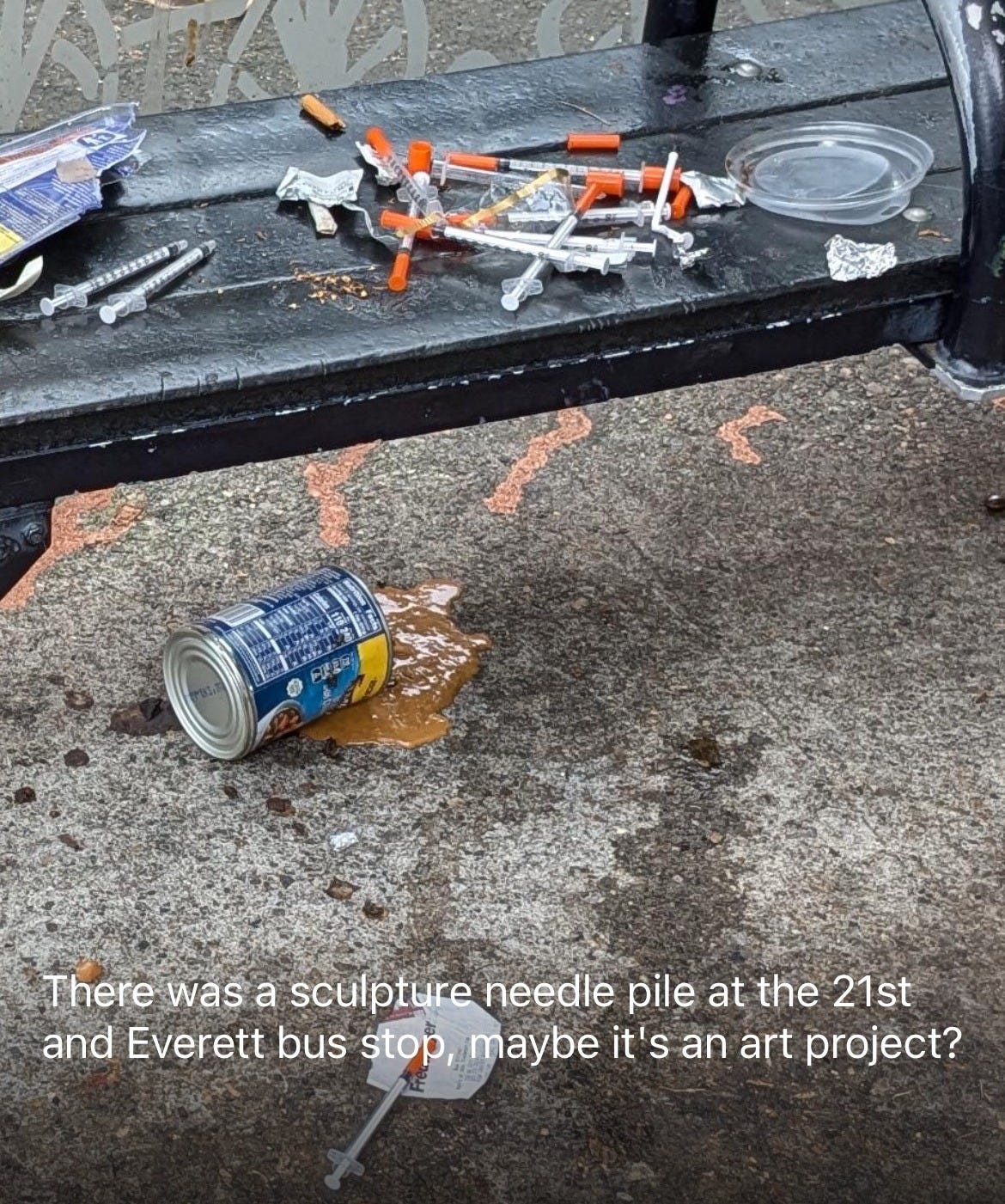
The video above is from December 2024 when during a neighborhood tour with Multnomah County Chair Jessica Vega Pederson, we encountered discarded syringes along our route. For many neighbors, the question was never abstract. It was always about place. It is the kind of question that emerges when you walk the same blocks every day. When you know where children walk to school, where neighbors gather, where people seek shelter, and where public systems intersect with ordinary life. It’s a place-based question.
For many that question arose from lived experience in August 2024, when neighbors gathered at St. Mary’s Cathedral to talk about what was happening on our blocks. What started as a neighborhood conversation became a structured effort. Through all of it, we kept returning to the same question:
Does location matter?
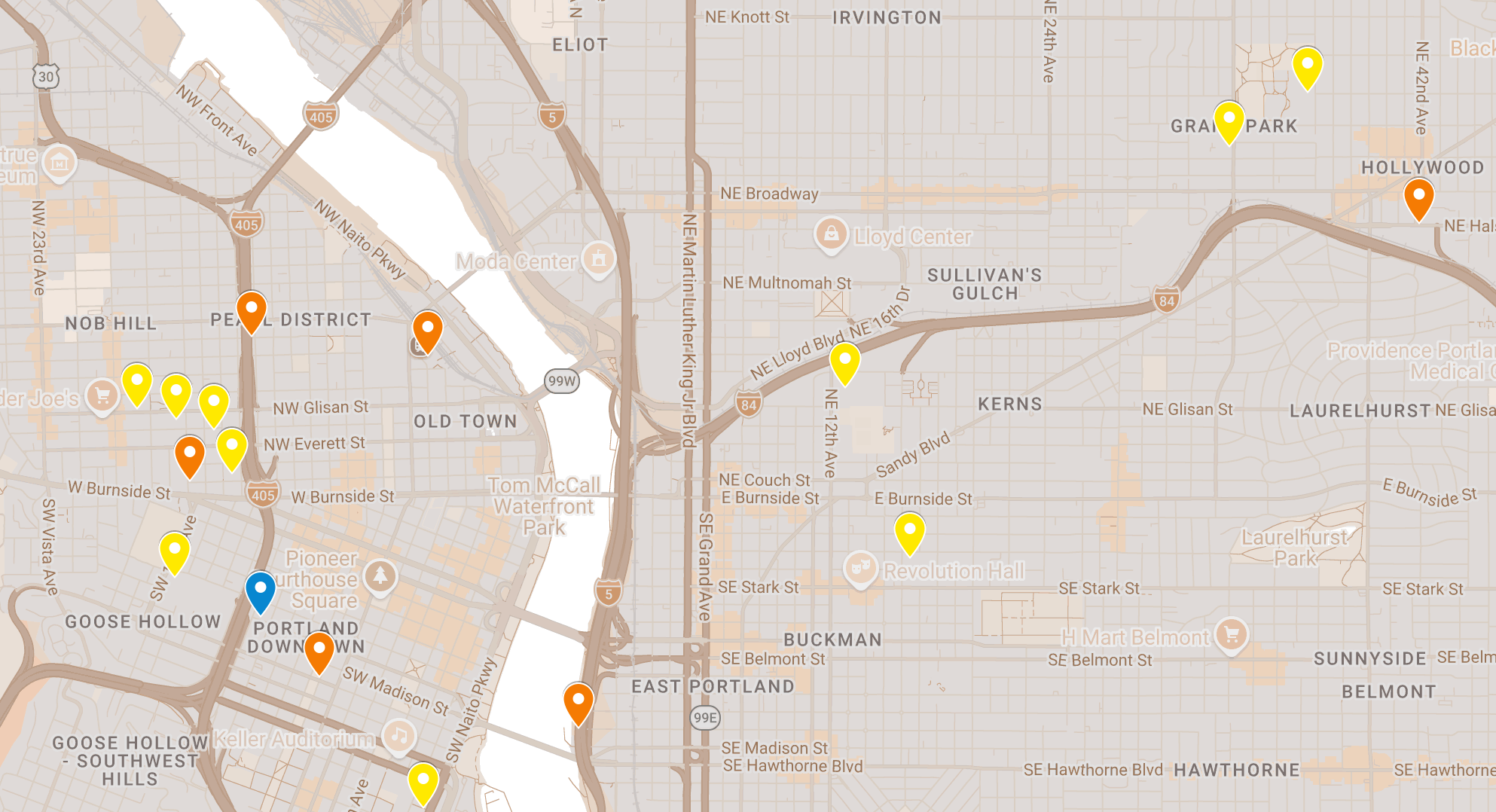
If location matters, then geography matters. This map visualizes the relationship between select schools and both mobile and fixed syringe service locations across Multnomah County:
For a long time, even raising a question about harm reduction locations was, and continues to be, interpreted as opposition to harm reduction itself. Yet over the past year, something has begun to shift. As Multnomah County1 advances its proposed Safe School Zones ordinance establishing a 1,000-foot buffer around K-12 schools for mobile syringe service programs, a new coalition has emerged.
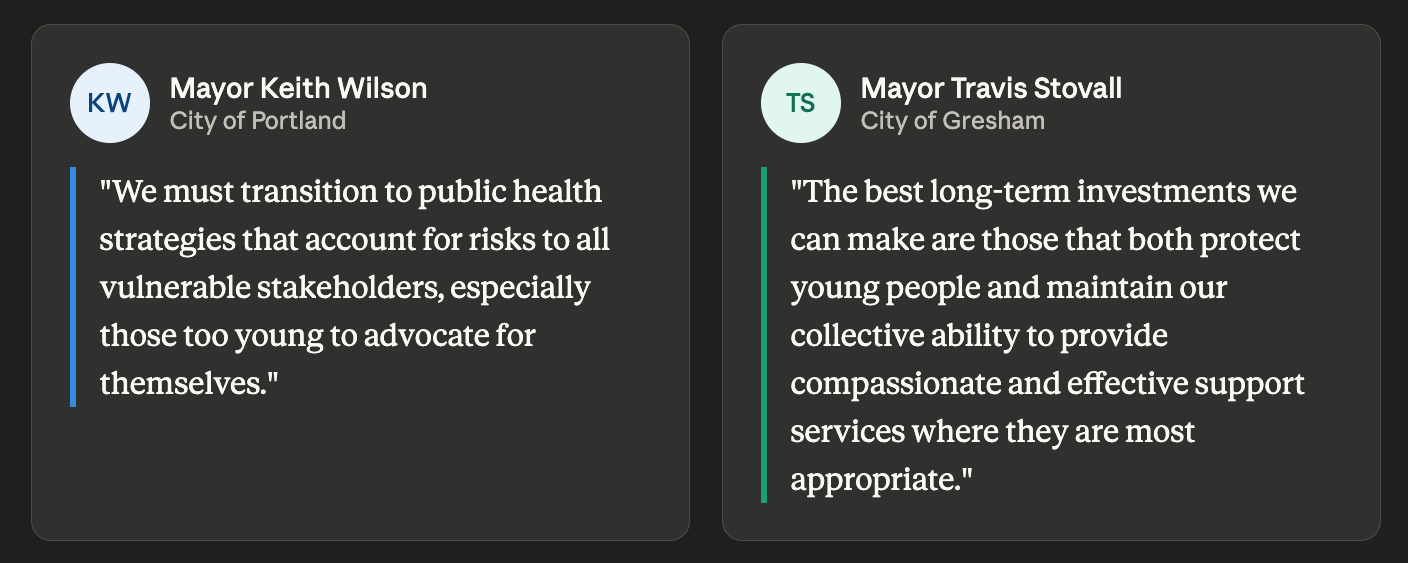
Mayor Keith Wilson submitted a formal letter supporting the ordinance becoming the first sitting Portland mayor to publicly endorse the principle that proximity to schools should factor into how mobile syringe distribution is governed. Wilson acknowledged concerns about children and families encountering improperly discarded syringes and described the proposal as a balanced approach to public health and community wellbeing. And he was not alone:


Gresham Mayor Travis Stovall also endorsed the proposal, emphasizing the responsibility governments have to balance public health objectives with community safety and the protection of spaces centered around youth and education.
Then we heard the Multnomah Education Service District, joined by school leaders representing Centennial, Corbett, David Douglas, and Reynolds school districts, submitted their own letter of support.
Children, they argued, should be able to travel to school, access playgrounds, and participate in after-school activities without encountering hazardous conditions that create concern for their safety.
Together, these endorsements tell a story. A question that was once raised primarily by neighbors is now being taken seriously by mayors, school superintendents, education leaders, county commissioners, and policymakers across the state.
Neighboring Clackamas County2 has already referenced the Safe School Zones framework and the legislative work surrounding SB 1573 in its own policy discussions. What began as a place-based question on a handful of blocks in Northwest Portland is now informing conversations beyond Multnomah County’s borders. Leaders in Washington County have begun exploring many of the same questions as local governments throughout the region wrestle with how public health services and communities intersect.
Not everyone suddenly agrees on harm reduction policy, nor is there consensus on addiction, treatment, housing, law enforcement, or the countless other issues that surround Oregon’s ongoing behavioral health crisis. What appears to be emerging though, is agreement around something much more basic.
Location matters.
The debate is seemingly slowly moving away from a false choice between compassion and accountability, and more leaders are willing to acknowledge that both values can exist at the same time. Public health matters. Treatment matters. Harm reduction matters. Schools and children matter. Neighborhood context matters.
The details of the proposed ordinance deserve careful attention. Its current draft leaves important questions unanswered about exemptions, registration, transparency, and enforcement. Those questions deserve thoughtful discussion before final adoption because boundaries only work when the public understands how they are applied. We need to know how they are enforced, and under what circumstances they can be overridden. In the meantime, PPOP continues its unregulated mobile outreach in Multnomah County.
Today’s testimony before the Multnomah County Board of Commissioners is on record and viewable below. Thank you to those neighbors who showed up to participate in this important discussion. The second reading, originally scheduled for May 28, has been delayed at the request of the Board Chair, indicating that additional questions remain unanswered.
Regardless of how those details are resolved, a question that once belonged to a handful of neighbors on a street corner in Northwest Portland is now being asked by many across the region. Does location matter?
Let your Multnomah County Commissioners know:
County Chair Jessica Vega Pederson: mult.chair@multco.us
Meghan Moyer, County Commissioner District 1: district1@multco.us
Shannon Singleton, County Commissioner District 2: district2@multco.us
Julia Brim-Edwards, County Commissioner District 3: district3@multco.us
Vince Jones-Dixon County Commissioner District 4: district4@multco.us
Multnomah County Board of Commissioners Agenda and Safe School Zone supporting documents May 21, 2026: https://multnomah.granicus.com/ViewPublisher.php?view_id=3
Clackamas County Board of County Commissioners April 28, 2026 Meeting Syringe Exchange Safety Barrier Ordinance: https://docs.clackamas.us/documents/drupal/a02573d8-568f-487c-b835-cbe5837fae4b
PPOP is not an aberration. It is harm reduction taken to its logical conclusion. If harm reduction were merely about protecting intravenous drug users from bloodborne infections and toxic impurities in their drugs, perhaps deference toward it would be justified.
The problem is that harm reduction is not a buffet, and the public cannot pick the parts it likes while rejecting the rest. Like it or not, harm reduction rests on socially untenable principles. Accommodating harm reduction in its present form as our only drug policy effectively means accepting the belief that a person in the grip of fentanyl addiction somehow retains so much autonomy that society has no right to judge the choices destroying his life. It also means accepting the idea that only addicts themselves can decide when they are ready for sobriety, regardless of the damage inflicted on families, neighborhoods, public spaces, and the addicts’ own futures in the meantime.
That is why it is not enough merely to persuade local leaders that “location matters.” Of course location matters. But the deeper problem is that the underlying philosophy of contemporary harm reduction often works against recovery itself. It normalizes chronic addiction, treats self-destruction as a lifestyle to be managed indefinitely, and regards coercion, pressure, and moral expectations as inherently suspect even when lives are collapsing.
A humane society cannot build its entire drug policy around preserving the autonomy of people who are plainly incapable of exercising meaningful autonomy. Real compassion means reducing misery, restoring order, and helping people escape addiction — not creating a permanent infrastructure that quietly accommodates it while insisting everyone else adapt.
The next step is not simply regulating where syringe vans park. It is rebuilding drug policy around sobriety, treatment, accountability, and recovery. Oregon needs far more involuntary treatment capacity, far more structured pathways into sobriety, and far less fear about admitting that some addicts are too impaired to make rational decisions for themselves. Public officials also need the courage to say openly that public order matters, that neighborhoods are not sacrifice zones, and that policies should be judged by whether they reduce addiction and human suffering — not by whether they satisfy the ideological assumptions of the harm reduction industry.
2 comments:
Glad to see Mayor Wilson sign on in support of this ordinance. One question: I have often heard him cite the city’s public safety power when he was advocating for his homeless shelter program even though technically homelessness services fall under the county. It seems to me that the same rationale could be used for the city to have a companion ordinance, one that perhaps could be better enforced with the city’s public safety powers.
Also, did PPS Superintendent Kimberlee Armstrong submit a separate letter in support of keeping needle distribution and drug use away from schools she supervises?